
Chesapeake court records contain official details of civil, criminal, traffic, and probate cases filed within Chesapeake, Virginia. These records are part of the Virginia court database, which organizes public case information from district and circuit courts for structured review. It helps store case activity in a clear and searchable format for public reference. Searching for Chesapeake Court records helps users review case filings, hearing activity, and party information tied to local courts. Many people use court records in Chesapeake, VA to check case status, confirm legal history, and find basic public case details. It supports quick review of case progress, dates, and related court actions.
This system brings together court data from Chesapeake’s local judiciary into one searchable structure within the Virginia court database. It supports case lookups using names, case numbers, or filing dates for faster record identification. The system keeps data grouped by court type for easier review. It also helps users compare older and recent case entries in one place. Users often rely on this record system for civil disputes, criminal matters, traffic violations, and probate cases. It delivers organized legal data that supports public record checks, case verification, and legal reference needs across Chesapeake, Virginia. It also helps track case movement through different court stages. Public record details remain structured for easy reading and quick reference.
What Are Chesapeake Court Records?
Chesapeake court records are official documents created during legal cases handled within Chesapeake courts. These records showcase activity, filings, rulings, and outcomes tied to civil and criminal matters. They serve as a structured record set that reflects how cases move through the local Virginia court system and are stored in a Virginia court database for reference and recordkeeping.

Definition of Chesapeake Court Records
Chesapeake court records refer to formal legal documentation produced during court proceedings in Chesapeake, Virginia. These records form part of the public judicial record system and reflect actions taken in each case from start to finish. They commonly exist as case files, legal documents, and court archive records maintained by court offices. Each file may represent one case or multiple related filings tied to a legal matter.
Record types often include:
- Civil case files
- Criminal case documentation
- Family law filings
- Traffic violation records
- Probate court materials
These records support legal transparency and provide a structured history of court activity within the jurisdiction.
What Information Court Files Include
Chesapeake court files contain detailed legal data tied to each case. These files often combine multiple document types that form a complete record of proceedings.
Common elements found inside case files and legal documents include:
- Party names involved in the case
- Filing dates and hearing schedules
- Motions, petitions, and responses
- Judge rulings and final judgments
- Evidence lists and submitted exhibits
- Sentencing details in criminal matters
- Settlement terms in civil disputes
A court archive record may also preserve older case materials that are no longer active but remain stored for reference and legal history.
How to Search Chesapeake Court Records Online
Chesapeake court records can be searched through official Virginia online court systems using a person’s name, case number, or filing date. These public records systems showcase details, court actions, and hearing information in a structured format. Most users start by selecting the correct court system, then running a search inside the online court database. Results appear based on matching case data from Chesapeake and other Virginia courts.
Identify the Correct Court Type First
Every case belongs to a specific court. Selecting the correct court helps return accurate search results.
Common court types include:
- Circuit Court: civil cases, divorce, felony matters
- General District Court: traffic tickets, misdemeanors
- Juvenile & Domestic Relations Court: family-related cases
Wrong court selection can lead to missing or incomplete records.
Use Official Chesapeake Court Search Tools
Virginia provides official systems for public records access and court case lookup.
Primary tools include:
- Virginia Online Case Information System (OCIS) Search: https://eapps.courts.state.va.us/ocis/search.
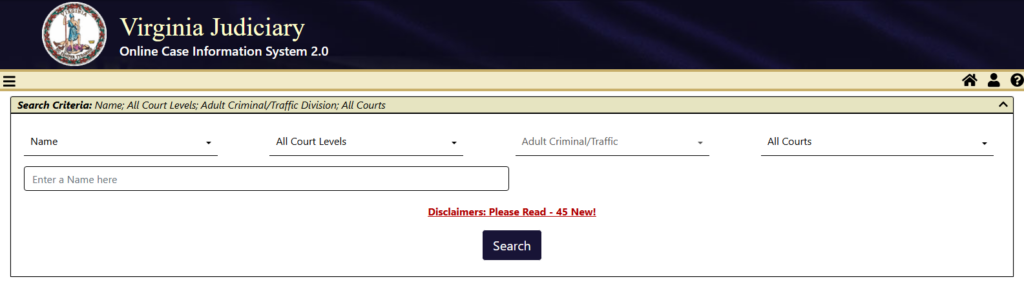
These tools are used for:
- name-based court case lookup
- case number search
- Hearing date review
- court record verification
How to Search Virginia General District Court Case Records
The Virginia General District Court Online Case Information System provides public access to court case records from district courts across Virginia. Users can search available records by selecting a court, choosing a case category, and using one of the available case search tools to locate court-related information.
- Open the official Virginia General District Court Online Case Information System:
- https://eapps.courts.state.va.us/gdcourts/landing.do#
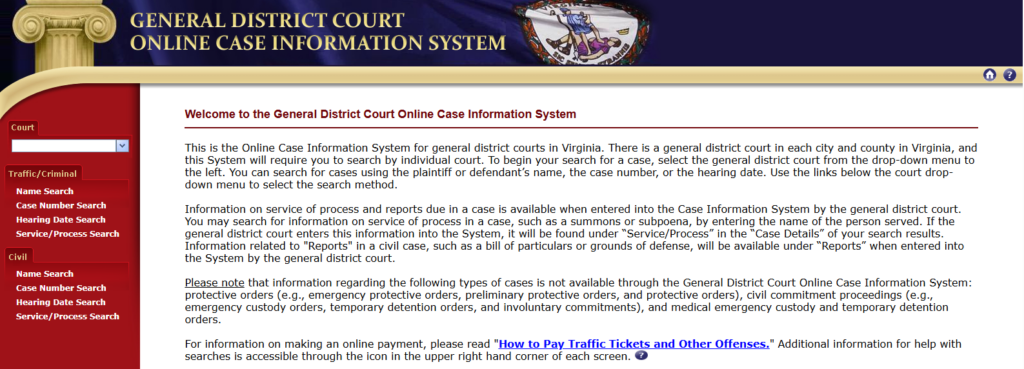
- Select the “Court” dropdown menu from the left sidebar.
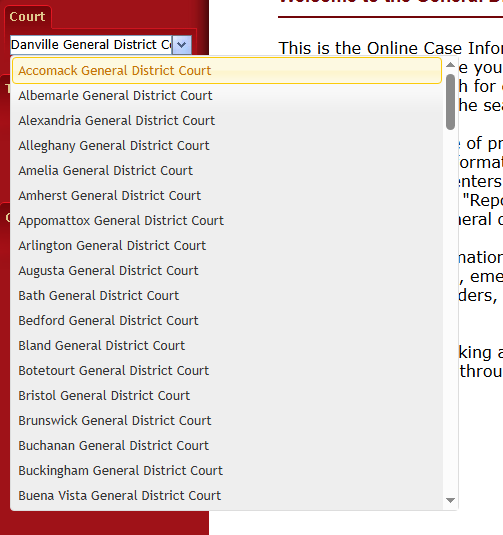
- Choose the appropriate Virginia General District Court based on the city or county connected to the case.
- View the available search categories displayed on the left side of the page, including:
- Traffic/Criminal
- Civil
- Click the category related to the type of case search needed.
- Open one of the available search tools, such as:
- Name Search
- Case Number Search
- Hearing Date Search
- Service/Process Search
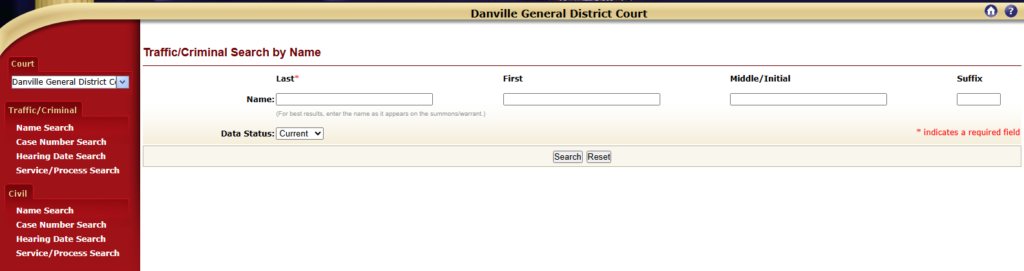
- Enter the required search details in the selected search form.
- Submit the search request to view available court case records.
- Review the case information, including hearing dates, case status, charges, and related court details when available.
Virginia Court Records and Case System
The Virginia court database system stores and organizes judicial records from courts across the state. It helps the public follow case activity, review court filings, and use the Virginia case tracking system for court-related searches. Virginia uses a structured judiciary that handles criminal, civil, traffic, family, and juvenile matters. Each court level has a different role, which helps courts process cases in an organized and timely way.
Structure of the Virginia Judicial System
The Virginia judicial system follows a tiered court structure. Each court handles specific legal matters based on the type of dispute, claim amount, or criminal charge.
The system includes:
| Court Level | Main Role | Common Case Types |
|---|---|---|
| Circuit Courts | Higher trial courts | Felony cases, major civil disputes, family appeals |
| General District Courts | Limited trial courts | Traffic violations, misdemeanors, small claims |
| Juvenile and Domestic Relations Courts | Family-related matters | Child custody, support, juvenile offenses |
| Court of Appeals | Reviews lower court decisions | Appeals from circuit and family courts |
| Supreme Court of Virginia | Highest state court | Constitutional and major legal appeals |
This structure keeps judicial records organized across multiple court divisions. Many records connect through the Virginia court database, which supports public case searches and court administration.
Circuit Courts in Virginia
Virginia Circuit Courts serve as the main trial courts in the state. These courts hear serious criminal cases and large civil disputes.
Circuit Courts commonly handle:
- Felony criminal charges
- Divorce proceedings
- Property disputes
- Probate matters
- Civil claims with higher dollar amounts
- Appeals from district courts
Each Circuit Court maintains court filings, hearing schedules, and case outcomes. Many records become part of the statewide judicial records system used for case tracking.
General District Courts
General District Courts process a large share of Virginia court cases every year. These courts focus on lower-level legal matters and simpler proceedings.
Case categories include:
- Traffic tickets
- Small claims cases
- Landlord-tenant disputes
- Civil claims with limited damages
- Misdemeanor offenses
Most hearings move quickly compared to higher courts. The Virginia case tracking system often lists hearing dates, case numbers, and filing updates from district courts.
Juvenile and Domestic Relations District Courts
Juvenile and Domestic Relations District Courts handle family and youth-related cases. These courts focus on matters involving children, guardianship, and household disputes.
Typical cases include:
- Child custody
- Child support
- Juvenile offenses
- Protective orders
- Family abuse matters
- Visitation disputes
Some records remain restricted to protect minors and private family details. Even so, portions of the Virginia court database may still show limited docket information for approved public viewing.
How the Virginia Court Database Supports Case Searches
Virginia courts use digital systems to organize court files and maintain judicial records across the state. These systems help court staff manage filings, hearings, judgments, and scheduling updates.
The statewide database often includes:
- Case numbers
- Party names
- Filing dates
- Hearing schedules
- Court locations
- Disposition details
Court users often rely on the Virginia case tracking system to monitor active cases and review public court activity. This process supports transparency within the Virginia judiciary and helps users locate case-related information more efficiently.
How Chesapeake Court Records Are Created and Stored
Chesapeake court records begin when a case enters the legal system through an official filing. Courts then update and store these records through hearings, judgments, appeals, and final case closure. The full process creates a detailed legal history that helps courts track case activity, filing dates, legal documents, and changes in case status.
Case Filing Starts the Court Record Process
A Chesapeake court record usually starts when a person, attorney, business, or government agency files documents with the court clerk. The clerk reviews the paperwork, assigns a case number, and enters the information into the court’s docket system. This system tracks the full case timeline, including filing dates, scheduled court hearings, motions, legal notices, and updates to the case status. Common filings include civil complaints, criminal charges, divorce petitions, probate forms, and traffic violations. Many courts now use electronic filing systems that help staff organize records more efficiently and reduce paper storage needs.
Court Hearings and Judgments Add More Records
Court records continue to grow during the hearing process. Judges, attorneys, witnesses, and court staff create new legal documents throughout each stage of the case. These records may include hearing transcripts, motions, court orders, evidence filings, sentencing details, and courtroom schedules. Each hearing can change the official case status, such as moving a case from pending to closed after a final decision. The docket system records every event in chronological order, creating a clear legal timeline. Final judgments are among the most important parts of the file, as they explain the court’s ruling, penalties, financial obligations, and other legal outcomes.
Appeals and Long-Term Court Record Storage
Some cases continue after judgment through the appeals process. During an appeal, a higher court reviews earlier decisions and creates new documents connected to the original case. Appeal records often contain appellate briefs, written opinions, oral argument schedules, and updated rulings. Chesapeake Courts may store records for many years, depending on the case type and state record retention rules. Serious criminal matters often remain archived permanently. Older files may be moved into secure court archive systems, where courts preserve legal history for future review. Many courts now use both digital databases and physical storage systems to protect records and maintain accurate long-term documentation.
Types of Court Records Available in Chesapeake
Chesapeake court records are grouped into distinct categories based on case type. Each category holds separate case files and legal documents tied to specific legal matters. The three main types include criminal records, civil cases, and traffic violations. These records often form part of public records maintained by local court systems. They reflect court activity ranging from arrests to disputes and minor infractions.
Criminal Records
Criminal records in Chesapeake relate to offenses handled through the criminal court system. These records show how law enforcement actions connect with court proceedings and final case outcomes.
They often include details such as:
- Charges filed: Lists of accusations presented in court
- Sentencing outcomes: Penalties, probation, or jail terms assigned by the court
- Arrest connection: Links between police arrest reports and court case filings
Criminal records may include felony and misdemeanor cases. Case files often show hearing dates, plea entries, and final judgments. These records form part of official criminal records databases used for case tracking within municipal and county court systems.
Civil Records
Civil records in Chesapeake focus on non-criminal legal matters between parties. These records relate to disputes that do not involve criminal charges but still require court resolution.
Common civil records include:
- Disputes between parties: Contract issues, financial claims, and disagreements
- Property issues: Boundary disputes, landlord-tenant matters, and ownership claims
Civil case files often contain complaints, responses, motions, and court rulings. These legal documents form part of civil cases processed through local courts. Many civil filings remain in public record systems for reference and case tracking.
Traffic Records
Traffic records in Chesapeake relate to violations involving road and driving laws. These records are typically processed in traffic or municipal court divisions.
Elements include:
- Traffic violations: Speeding, signal violations, and driving offenses
- Fines and penalties: Court-issued monetary penalties or required actions
Traffic violations often appear in court docket entries linked to individual driving records. These records may include citations, hearing outcomes, and payment status for fines. Traffic-related case files help track repeat offenses and court decisions tied to roadway safety enforcement.
Court Docket System and Case Tracking Process
A court docket system is a structured record that shows all activity linked to a case. It lists filings, court hearings, and every update that changes a case’s status over time.
In Chesapeake Court records, the docket acts like a timeline that tracks each step of a case from start to finish.
Meaning of a Docket and Case Status Updates
The term docket refers to an official case record maintained by the court. It organizes case information in a step-by-step format so each action stays recorded in order. This includes filings, motions, rulings, and updates from judges or clerks. A key function of the docket system is to show case status. Case status reflects where a case currently stands in the legal process. It may show stages such as filed, active, pending hearing, or closed. Each update appears when new activity happens in the case file. For example, when a motion is submitted, the docket records the filing date and type. When a judge responds, the entry updates again.
Common docket details include:
- Case number and party names
- Filing dates and case type
- Motion submissions and rulings
- Status changes and court actions
This structured format helps users follow the full case timeline without missing key updates. It also supports consistent tracking across civil, criminal, and traffic matters.
Hearing Scheduling and Court Hearing Records
Court hearings are scheduled directly through the docket system. Each hearing entry lists the date, time, and courtroom assignment. This allows case participants to know when they need to appear or respond. The docket also shows changes in court hearings, such as rescheduling or cancellations. These updates are recorded quickly to reflect current court activity.
A simple breakdown of hearing-related docket entries:
| Docket Entry Type | Description |
|---|---|
| Hearing Scheduled | Sets date and time for court appearance |
| Hearing Rescheduled | Delays the hearing to a later date |
| Hearing Completed | Mark’s hearing has finished |
| Continuance | Delays hearing to a later date |
Each entry keeps the case record accurate and up to date. Attorneys, plaintiffs, and defendants rely on these entries to stay informed about court activity and next steps in the process.
Role of the Chesapeake Clerk of Court
The Chesapeake Clerk of Court serves as the official record keeper for court filings, legal paperwork, and case documentation in Chesapeake courts. This office handles record filing responsibility, document management, and public viewing of selected court records within legal limits. It keeps all court information organized, so case tracking, case history, and judicial processing remain consistent and properly recorded. The clerk’s office also supports clerk’s office records and legal documents, making sure each file is stored and maintained in a structured system for court use.
Record Filing Responsibility
The Chesapeake Clerk of Court manages the filing of legal documents submitted during court cases, including civil, criminal, and traffic matters. Each filing is reviewed for correct format and then entered into the official system under the assigned case number for tracking. Once recorded, it becomes part of the case history and is updated whenever new motions, orders, or rulings are added. This process supports accurate clerk office records and keeps case tracking consistent across all court matters.
Document Management
The document management system focuses on organizing and storing both physical and electronic court records. Files are arranged by case type, date, and case number so they can be located quickly when needed. As cases move forward, new filings and court decisions are added to the record, while older documents are preserved in secure archives. This structured system supports reliable legal document access and keeps court records properly maintained for long-term use.
Public Viewing Role
The Chesapeake Clerk of Court also manages public viewing of selected court records under legal guidelines. Certain case details, such as civil and traffic records, may be reviewed through approved channels, while sensitive or sealed information remains restricted. This system supports transparency in court operations while protecting confidential material. It also helps manage requests for clerk office records in a controlled and organized way, ensuring only eligible legal documents are made available for public review.
Are Chesapeake Court Records Public?
Chesapeake court records are public under the Virginia Freedom of Information Act (FOIA) principles. Most case information stays open to support legal transparency and public records access. Some records remain restricted by law and cannot be viewed without special permission. These limits protect sensitive case types and personal privacy.
FOIA Principles and Legal Transparency in Chesapeake Courts
Virginia FOIA sets the rules for public records access in court systems, including Chesapeake. It supports legal transparency by allowing the public to view many judicial documents. Court records often include case details such as filings, motions, and final rulings. These records help maintain accountability within the court system. They may be reviewed through official court databases or clerk offices. FOIA principles focus on openness while balancing privacy needs. This balance allows the public to review legal outcomes without exposing sensitive personal data.
Publicly available court records include:
- Civil case filings
- Criminal case outcomes
- Traffic violation records
- Court hearing schedules
These records support public records access and help explain how cases move through the judicial system.
Restricted Court Records in Chesapeake
Not every court record is open for public review. Virginia law limits certain case types to protect individuals and sensitive information.
Restricted records often include:
- Juvenile cases: Cases involving minors remain confidential to protect identity and future privacy
- Sealed records: A court order may block public visibility of specific case files
- Expunged records: Removed from public view after legal approval
These restrictions support legal privacy rules while still preserving court accountability where appropriate.
Common Mistakes When Searching Court Records
Court record searches often return missing or incorrect results due to data and indexing issues. Users face spelling differences, outdated entries, and sealed case limits when using Chesapeake court databases. Search results from court systems do not always match user input exactly. Small differences in spelling, formatting, or record updates often create confusion during case lookup issues.
Spelling mismatches and name variations
Name spelling differences frequently affect case lookup issues in Chesapeake court databases. Court staff may enter names with typos, alternate initials, or different formats. These small changes often trigger court database errors during searches.
Variations include:
- “John A. Smith” vs “Jon Smith”
- “McDonald” vs “MacDonald”
- Hyphenated surnames vs single-word formats
Phonetic matches may not trigger results in many systems. As a result, users may miss relevant criminal records, civil filings, or traffic cases even when records exist in the system.
Outdated records and sealed case restrictions
Court systems may not reflect real-time updates after hearings or filings. Some entries appear late due to processing delays across clerical workflows. This delay often creates gaps in case lookup issues.
Certain records remain hidden from public view due to legal limits. These include:
- Juvenile case files
- Expunged records
- Active investigations under restriction
| Issue Type | Impact on Search |
|---|---|
| Outdated updates | Missing recent filings |
| Sealed cases | No public results shown |
| Processing delays | Partial or incomplete data |
Court database errors can also appear when systems sync across multiple departments. These issues reduce search accuracy and affect public record visibility across Chesapeake court databases.
(FAQs) About the Chesapeake Court
Chesapeake court records are handled through Virginia’s official court record systems and local clerk offices. These records include civil, criminal, and traffic case details stored in structured databases. Users often search by name, case number, or filing type to review available court information.
How do Chesapeake court records get found?
Chesapeake court records are located through Virginia judicial record systems and clerk-maintained case databases. Searches usually involve entering a case number, party name, or filing type into the court’s online portal. Criminal, civil, and traffic matters appear based on what the court has processed and entered into its system. Each result may show case status, hearing dates, and party details. Older files or restricted documents may require a direct request from the courthouse. This process supports public record transparency across Chesapeake court data.
Are Chesapeake court records free to view?
Some Chesapeake court records can be viewed without payment through public case search tools. These free listings usually show basic details such as case numbers, party names, and hearing schedules. Full documents like affidavits, motions, or judgments may require payment through the clerk’s office. Certified copies also carry an official fee set by court policy. Costs depend on the type of record requested and the format needed. Public summary data remains the most commonly available free option in most court systems.
Can Chesapeake court records be searched using a name?
Chesapeake court systems allow searches using a person’s first and last name. This method helps locate civil disputes, criminal cases, and traffic violations linked to an individual. Results may show multiple entries if the name matches more than one case or person. Variations in spelling or aliases can also affect search outcomes. Filters are often available to narrow results by case type or filing date. Name-based searches remain one of the most used methods for reviewing court activity.
How often are Chesapeake court records updated?
Chesapeake court records are updated on a routine basis, depending on case processing speed and court workload. New criminal filings often appear within one to three business days after entry. Civil matters may take a few additional days before appearing in the system. Traffic-related updates can follow weekly processing cycles in some departments. Updates depend on clerk review and official case validation steps. This timing means records may not always reflect real-time changes in ongoing cases.
Can Chesapeake court records show case status and outcomes?
Chesapeake court records often display case status and outcomes once the court completes processing. Users can see whether a case is open, closed, dismissed, or resolved through judgment. These records may also include sentencing details in criminal matters and settlement notes in civil disputes. Traffic cases can show fines, violations, or court rulings after review. Some updates appear after clerk verification and judicial entry into the system. This information helps track the full progress of Chesapeake court cases from filing to resolution.